
Marriage is. . .
After 48 years, I learn a surprising answer

A New Country
Many churches across the United States are experiencing phenomenal growth. I understand that is true of many Orthodox churches, and certainly true of my own parish in Albuquerque. I would say that Sunday attendance has at least tripled (yes, that’s 3x) what it was when I began attending about two and a half years ago. People are not running away from, but toward, the most ancient and unchanging Christian Church.
Most non-Orthodox people experience a kind of culture shock the first time they enter an Orthodox worship. It’s truly like another country for most. (“Bells and smells.” And I’ll be the first to admit, some of what I saw was unsettling to me.)
However, I’m finding the biggest differences in my mind aren’t the sights and sounds of Orthodoxy but rather some of the underlying assumptions. Here are two of them:
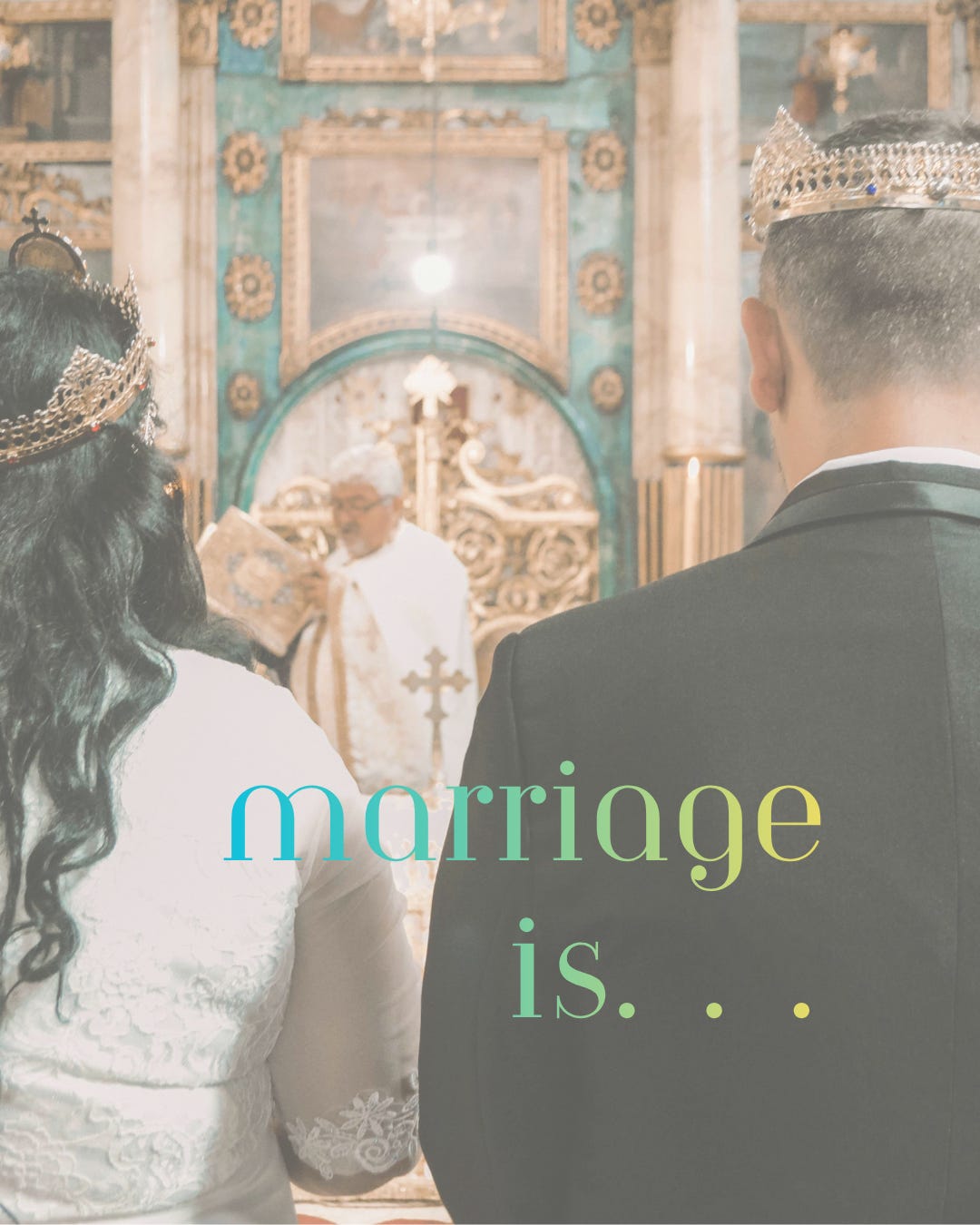
Marriage as Martyrdom
First, the Orthodox view of marriage. If you’ve been to a wedding ceremony there, it’s quite different! I’d like to focus on one specific aspect. At one point the priest puts one crown on the bride’s head, and one on the groom’s. The symbolism of the crowns is multi-faceted. They’re joined by a white ribbon (unity) and show they’re to be king and queen of their household. Their own kingdom, replicating the Kingdom of God. But most significant is an aspect I have never heard of before. The crowns symbolize martyrdom.
I teach a writing class where I give prompts. Recently the prompt was to finish this sentence: “Marriage is. . .”
For Orthodox, marriage is martyrdom.
And consciously, deliberately, the Orthodox bride and groom at the beginning of their lives together, think of death. Later in the ceremony, the martyrs of Christian history are mentioned. The bride and groom are joining a venerable and exclusive club.
You Can’t Take Away My . . .
The second underlying assumption that I’m absorbing in Orthodoxy is the sobering weight of the history of these people who’ve been willing to give their lives up for Christ. I read every day on the OCA.org website about people for the last 2000 years (and many before that) who stood up to unthinkable tortures and privations for the name of Jesus.
I know, the Bible talks about personally taking up an instrument of torture and disgrace (a cross), of dying to self, of the inequality in every way of earthlife to eternal existence.
But I’ve never heard it put this way: Father Thomas Hopko (blessed memory – he reposed – passed away -- in 2015), once told of interviewing a monk he knew. This man had suffered greatly for Christ. He’d lost almost everything that was precious to him. He said this:
“Keep your icons. Keep your crosses. Keep your churches. Keep your monasteries. Keep your books. Keep your liturgies. Take away everything you want.”
His bottom line, though, shocked me. He said,
“But they can’t take away our death.”
He continued. “Because in our death, we are united to the death of the Lord Jesus Christ, and through His death, we enter into His resurrection and life eternal.”
I don’t know about you, but I certainly have been quite preoccupied with my life. But I’ve not daily, hourly kept in mind the fact that someone could indeed forcibly take everything I own, then take my life.
But, like the monk, I now see that would just be a moment.
I’m not young. I’m not strong. Almost anybody could take my life from me.
But if I’ve considered my life as loss anyhow,
Nobody, nobody, nobody can take away my death.
Brilliant reframing of marriage and death particularly! Thank you.